Engine oil for UAE weather is not just about picking a popular brand or choosing the thickest oil on the shelf. In Sharjah, your engine oil has to handle high temperatures, dusty roads, stop-and-go traffic, long idling, and summer driving conditions that can put extra stress on the engine.
Many car owners only think about engine oil when the service reminder appears. But the wrong oil grade, poor-quality oil, delayed oil change, or using oil that does not match your vehicle’s specification can lead to rough performance, higher wear, oil burning, sludge, and expensive engine repair.
The right engine oil helps protect the engine, reduce friction, control heat, clean internal parts, and support smooth performance. If you are not sure which oil is right for your car, book a quick inspection at Sharjah Auto Workshop before your next oil change.
A quick check today can prevent a more expensive repair later.
What Engine Oil Actually Does
Engine oil is more than a lubricant. It protects moving engine parts that operate under heat, pressure, and friction.
Good engine oil helps:
- Reduce metal-to-metal wear
- Support smooth engine operation
- Carry heat away from internal parts
- Keep contaminants suspended until the oil filter catches them
- Protect seals and internal components
- Reduce sludge formation
- Support fuel efficiency when the correct grade is used
In UAE weather, oil works harder because the engine often runs in hot ambient temperatures, heavy traffic, and long AC-load conditions. That does not mean every car needs thicker oil. It means the oil must match the manufacturer’s required viscosity and specification while also being suitable for local driving conditions.
Choosing engine oil by guessing is risky. The correct choice depends on your vehicle make, model, engine type, mileage, driving style, and manufacturer recommendation.
Why Engine Oil for UAE Weather Matters in Sharjah
Sharjah drivers face conditions that are tough on engine oil.
Daily driving may include slow traffic, dusty roads, short city trips, long idling with AC on, weekend drives to other Emirates, and summer heat. These conditions can cause oil to degrade faster than it would in cooler climates.
Common UAE driving conditions that affect oil include:
- High outside temperature during summer
- Long time spent in traffic
- Frequent AC use increasing engine load
- Dust entering through poor filters or delayed maintenance
- Short trips where the engine does not fully warm up
- Long highway drives between Sharjah, Dubai, Ajman, and other Emirates
- Heavy vehicle use for family, work, or delivery driving
- Older engines with higher oil consumption
This is why car maintenance in Sharjah should not be based only on a general schedule. Your driving pattern matters.
If your car is used daily in traffic or long summer drives, ask Sharjah Auto Workshop to check the oil condition, oil level, filter condition, leaks, and service history before choosing the next oil.
Common Signs You May Be Using the Wrong Engine Oil
The wrong oil may not damage the engine immediately, but it can create symptoms over time. Some signs can also come from other engine issues, so professional inspection is safer than guessing.
1. Rough engine sound after oil change
If your engine sounds louder, rougher, or more “tappy” after an oil change, the oil grade or quality may not be suitable. This can happen when the oil is too thin, too thick, or not matching the required specification.
2. Oil level drops too quickly
Some engines naturally consume a small amount of oil, especially with age. But if the oil level drops quickly after service, there may be burning, leakage, wrong oil viscosity, worn seals, or another engine issue.
3. Oil warning light appears
An oil warning light should never be ignored. It may indicate low oil level, low oil pressure, sensor issues, or a serious lubrication problem.
If the oil pressure warning appears while driving, stop safely and contact a workshop.
4. Burning oil smell
A burning smell can happen when oil leaks onto hot engine parts. It can also point to overfilling, gasket leaks, or worn components.
5. Dark, thick, or dirty oil
Oil naturally darkens as it works, but very thick, sludgy, or gritty oil may suggest delayed maintenance, poor oil quality, or harsh driving conditions.
6. Engine feels less smooth
If the car feels less responsive, rough at idle, or heavier than usual after an oil change, the oil may not be right for the engine. It may also be time for vehicle inspection Sharjah drivers can trust.
7. Frequent top-ups between services
If you keep adding oil between services, do not just continue topping it up. Book an inspection to check for leaks, oil burning, PCV issues, gasket condition, or engine wear.
For urgent help in Sharjah, contact the workshop by call or WhatsApp and explain your car issue.
Understanding Oil Viscosity Without Confusion
Most engine oils have labels such as:
- 0W-20
- 5W-30
- 5W-40
- 10W-40
- 15W-40
These numbers refer to oil viscosity, which means how the oil flows at different temperatures.
The first number with “W” relates to cold-start flow. The second number relates to oil thickness at operating temperature.
For example, 5W-30 and 5W-40 may both flow well during startup, but 5W-40 remains thicker at operating temperature than 5W-30.
That does not mean 5W-40 is automatically better for UAE weather. Modern engines are designed with specific oil clearances, oil pumps, turbochargers, sensors, and emission systems. Using oil that is too thick can reduce efficiency, affect oil flow, and create other issues.
The safest rule is simple:
Use the oil viscosity and specification recommended for your vehicle, then adjust only when a qualified technician confirms it is suitable based on the engine condition and local use.
Step-by-Step Guide: How to Choose the Right Engine Oil
Step 1: Check the owner’s manual first
The owner’s manual or service booklet usually lists the correct oil viscosity and required standard. This may include viscosity grades and performance specifications.
Do not rely only on what “worked” in another car. A Toyota, Nissan, BMW, Mercedes-Benz, Hyundai, Kia, Ford, or Mitsubishi may require different oil depending on the engine.
If you do not have the manual, share your car model, year, engine size, and mileage with Sharjah Auto Workshop so the team can guide you properly.
Step 2: Match the correct oil grade
The oil grade should match the manufacturer’s recommendation. Common grades in the UAE include 0W-20, 5W-30, 5W-40, and 10W-40, but the right choice depends on the car.
A newer engine may require low-viscosity synthetic oil. An older, high-mileage engine may need closer inspection before changing grade.
Do not switch to thicker oil just because the weather is hot. Thick oil may hide some symptoms temporarily, but it can also create new problems if the engine was not designed for it.
Step 3: Choose the right oil type
Engine oil usually comes in different types:
Fully synthetic oil
Fully synthetic oil is often used in modern vehicles because it offers strong heat resistance, stable performance, and better protection under demanding conditions.
Semi-synthetic oil
Semi-synthetic oil may be suitable for some vehicles depending on the engine and manufacturer recommendation.
Mineral oil
Mineral oil is generally used in older engines or specific applications. It is not suitable for many modern engines.
The best option depends on the car, not just the climate. If you are not sure what oil your car needs, book a quick inspection at Sharjah Auto Workshop before the oil change.
Step 4: Consider your driving conditions
Your oil choice and oil change schedule should consider how you drive.
You may need closer maintenance if you often drive in:
- Heavy Sharjah traffic
- Dusty industrial areas
- Long highway routes
- Summer heat with AC running
- Short trips with frequent starts
- Delivery or commercial use
- Long idling
- Stop-and-go school or office runs
These conditions can break down oil faster and make regular car maintenance in Sharjah more important.
Step 5: Check oil level and condition regularly
Even the right oil will not protect the engine if the level is low.
Check oil level when the car is parked safely on level ground. Follow the correct dipstick process for your vehicle. Some newer cars use electronic oil level readings, so check the dashboard menu if your car does not have a traditional dipstick.
Watch for:
- Low oil level
- Oil smell
- Sludge on the oil cap
- Oil leaks under the car
- Oil stains around the engine
- Warning lights
- Sudden change in engine sound
If anything looks unusual, do not keep driving for long. Contact a Sharjah car workshop for inspection.
Step 6: Replace the oil filter with the oil
Changing oil without replacing the oil filter can reduce the benefit of the service. The filter helps trap contaminants and particles from the engine oil.
A poor-quality or clogged oil filter may affect oil flow and engine protection.
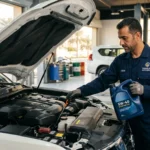
At Sharjah Auto Workshop, oil service can include oil replacement, filter replacement, fluid checks, visual inspection, and a general look at related wear items when needed.
Step 7: Ask for a basic inspection during oil service
An oil change is a good time to inspect the vehicle. A technician may check:
- Engine oil leaks
- Coolant level
- Brake fluid level
- Transmission fluid condition where accessible
- Battery health
- Belts and hoses
- Tyre condition
- Brake condition
- Warning lights
- Basic electrical concerns
- Signs of oil burning or sludge
This is where a simple oil change becomes smart preventive maintenance.
If you are already visiting for engine oil service, ask the team to check other basic items before UAE summer gets harder on the car.
Mistakes to Avoid When Choosing Engine Oil
Mistake 1: Choosing oil only by brand
A good brand is important, but the oil must still match the correct grade and specification. A premium oil with the wrong viscosity may still be wrong for your engine.
Mistake 2: Using thicker oil because UAE is hot
This is one of the most common mistakes. UAE heat matters, but your engine’s design matters more. Do not change viscosity without professional advice.
Mistake 3: Mixing different oils without checking
Topping up with the wrong oil may affect performance. If you are unsure, ask a workshop before mixing oil grades or types.
Mistake 4: Ignoring service intervals
Oil breaks down over time and use. Delaying oil changes can increase sludge, wear, and engine stress.
Mistake 5: Skipping the oil filter
The oil filter should usually be replaced during oil service. A dirty filter can reduce the quality of the oil change.
Mistake 6: Waiting for a warning light
Oil problems should not be handled only after a dashboard warning. By the time the light appears, the engine may already be at risk.
Mistake 7: Using cheap oil with unknown quality
Poor-quality oil can lose protection faster, especially in UAE summer driving. Always use oil that matches your car’s requirement.
When You Should Stop Driving and Contact a Workshop
Some oil-related symptoms need immediate attention.
Stop safely and contact a workshop if you notice:
- Oil pressure warning light
- Knocking or heavy ticking engine sound
- Strong burning oil smell
- Smoke from the engine bay
- Large oil leak under the car
- Engine running rough suddenly
- Low oil level with no spare oil available
- Engine power dropping badly
- Dashboard warning combined with unusual engine noise
Do not continue driving if the oil pressure warning appears. Low oil pressure can cause serious engine damage.
For urgent help in Sharjah, contact the workshop by call or WhatsApp and explain your car issue, location, and whether the car is safe to drive. If needed, roadside assistance in Sharjah may be safer than driving further.
Inspection and Oil Service Process at Sharjah Auto Workshop
Sharjah Auto Workshop does not choose engine oil by guesswork. The final recommendation depends on inspection, vehicle details, and manufacturer requirements.
A proper oil service or inspection may include:
1. Vehicle details check
The team checks your car make, model, year, engine type, mileage, and service history.
2. Oil specification check
Technicians confirm the recommended oil grade and oil type suitable for your vehicle.
3. Visual inspection
The engine bay is checked for oil leaks, stains, damaged hoses, worn belts, loose caps, and signs of poor previous maintenance.
4. Oil level and condition check
The oil level, smell, thickness, and visible condition are checked. Sludge or burnt oil smell may point to delayed maintenance or internal issues.
5. Oil and filter replacement
The correct engine oil and suitable filter are installed based on the vehicle requirement.
6. Fluid and safety checks
Depending on the service, technicians may check coolant, brake fluid, battery condition, tyre condition, and other basic maintenance points.
7. Computer diagnostics if needed
If warning lights are present, car diagnostics Sharjah drivers can rely on may be needed to check engine codes and sensor-related issues.
8. Road testing if needed
If the car has noise, rough running, or performance concerns, a road test may help confirm the issue after inspection.
9. Final service advice
The technician explains what was found and what should be repaired now, monitored, or planned for later.
Before booking, confirm availability, estimated cost, and required service so you know what to expect.
Cost Factors Without Fake Prices
The cost of engine oil service depends on several factors. A fixed price without checking the vehicle may not be accurate.
Cost factors include:
- Car make and model
- Engine size
- Oil quantity required
- Oil grade and specification
- Fully synthetic, semi-synthetic, or other oil type
- Oil filter type
- Whether additional inspection is needed
- Whether oil leaks are found
- Whether warning lights need diagnostics
- Whether other fluids or maintenance items need attention
A regular oil change is different from diagnosing oil leaks, burning oil, sludge, or engine noise.
Share your car model, issue, and location so the team can guide you properly.
Why Choose Sharjah Auto Workshop?
Sharjah Auto Workshop helps drivers with practical car repair in Sharjah, oil service, engine checks, diagnostics, car maintenance, battery checks, tyre checks, brake checks, electrical repair, AC service, and roadside support.
Choose the workshop if you want:
- Correct oil selection based on your vehicle
- Inspection before recommending repairs
- Clear advice without unnecessary upselling
- Oil level and leak checks
- Filter replacement guidance
- Support for high-mileage engines
- Help with warning lights and diagnostics
- Local understanding of UAE heat, dust, and traffic
- A practical auto workshop in Sharjah for regular maintenance
The goal is simple: use the right oil, protect the engine, and catch small problems before they turn into expensive repairs.
If you are not sure what is causing the problem, book a quick inspection at Sharjah Auto Workshop.
Helpful Checklist for Car Owners
Before booking your oil service, note these details:
- Car make, model, and year
- Engine size if known
- Current mileage
- Last oil change date or mileage
- Oil grade used last time if known
- Any warning lights
- Any oil leaks under the car
- Any burning smell
- Any unusual engine noise
- Whether you drive mostly in traffic or highways
- Whether the car is used for delivery, work, or family driving
- Your location in Sharjah
- Whether you need inspection, oil change, or roadside help
This helps the workshop guide you more accurately.
Areas Served in Sharjah
Sharjah Auto Workshop serves drivers across Sharjah and nearby areas, including:
- Sharjah Industrial Area
- Al Nahda Sharjah
- Al Majaz
- Al Qasimia
- Abu Shagara
- Al Khan
- Al Taawun
- Muwailih
- Rolla
- University City area
- Sharjah Airport area
- Sajja
- Nearby routes between Sharjah, Dubai, and Ajman
If you are dealing with low oil, oil leaks, warning lights, or delayed maintenance, contact the workshop and explain your location.
Strong Call-to-Action
Choosing the right engine oil for UAE weather protects your car from unnecessary wear, rough performance, oil sludge, and avoidable engine problems. The right oil depends on your vehicle, engine condition, mileage, and how you drive in Sharjah.
For reliable guidance, contact Sharjah Auto Workshop by call or WhatsApp. Share your car model, mileage, issue, and location so the team can guide you properly and help you book the right inspection or oil service.
A quick check today can prevent a more expensive repair later.
3. FAQ Section
1. What is the best engine oil for UAE weather?
The best engine oil for UAE weather depends on your car manufacturer’s recommended grade, engine type, mileage, and driving conditions. Do not choose oil only because it is thicker or popular. A professional oil check can confirm the correct viscosity and specification for your car.
2. Should I use thicker engine oil in Sharjah summer?
Not always. Many modern engines are designed for specific oil grades, and using oil that is too thick can affect oil flow and performance. It is better to follow the manufacturer recommendation and ask a technician before changing viscosity.
3. Is fully synthetic oil better for UAE heat?
Fully synthetic oil is often suitable for modern cars because it handles heat and stress well. However, the oil still needs to match your vehicle’s required grade and specification. The right choice depends on inspection and manufacturer guidance.
4. How do I know if my engine oil needs changing?
Signs include dark or thick oil, low oil level, rough engine sound, burning smell, oil warning light, or overdue service mileage. If you are unsure, book a quick inspection at Sharjah Auto Workshop before continuing long drives.
5. Can wrong engine oil damage my car?
Yes, using the wrong oil can affect lubrication, oil pressure, engine protection, and long-term reliability. Damage may not happen immediately, but repeated use of the wrong oil can increase wear.
6. Why does my car lose engine oil between services?
Oil loss may happen because of leaks, oil burning, worn seals, PCV issues, or engine wear. Do not keep topping up without inspection. A workshop can check whether the oil is leaking externally or burning internally.
7. Should I drive if the oil warning light comes on?
No, you should stop safely and contact a workshop. The oil warning light may indicate low oil pressure, which can damage the engine quickly if ignored.