In UAE driving conditions, engine oil is not just a routine maintenance fluid it is the core protection layer between extreme heat, constant traffic stress, and your engine’s internal components.
After years of working inside Sharjah Industrial Area workshops, one thing becomes very clear from real vehicle inspections:
engines rarely fail suddenly. They fail because oil performance quietly drops long before the driver notices.
Most car owners still follow generic advice like “change oil every 10,000 km.” That may work in moderate climates, but UAE conditions are completely different. High temperatures, long idling hours, dust exposure, and heavy AC load all accelerate oil degradation.
So the real professional question is not just mileage it is:
When does engine oil actually stop protecting your engine in UAE conditions?
Why Engine Oil Degrades Faster in UAE
Engine oil in UAE works under extreme thermal pressure almost every day. Unlike cooler regions, engines here rarely experience full cooling cycles, especially in cities like Sharjah and Dubai where traffic is frequent and stop-start driving is constant.
Heat is the biggest factor. When engine temperature stays high for long periods, oil loses viscosity faster, reducing its ability to properly lubricate moving components. Over time, this leads to increased friction and micro wear inside the engine.
Dust is another hidden contributor. Fine particles enter the system through air intake over time, especially if air filters are not replaced on schedule. This contaminates oil and reduces its effectiveness even before the recommended mileage interval.
Short trips also play a major role. Many drivers assume low mileage means healthy oil, but frequent short trips prevent oil from reaching optimal operating temperature, which leads to moisture buildup and faster degradation.
Real Workshop-Based Oil Change Intervals in UAE
From real diagnostic experience across Japanese, Korean, German, and American vehicles, the practical oil change intervals in UAE conditions are more conservative than manufacturer recommendations.
For mineral oil engines, the safe range is typically around 4,000 to 5,000 km. Semi-synthetic oil performs slightly better and usually lasts between 6,000 and 7,000 km under normal driving conditions.
Full synthetic oil offers the best protection, but even in UAE heat, it should ideally be changed between 7,000 and 10,000 km depending on driving style.
However, mileage alone is not enough. Time matters equally. Even if the vehicle has not reached the mileage limit, oil should generally be changed every 5 to 6 months due to heat and environmental exposure.
Why Manufacturer Oil Intervals Don’t Match UAE Reality
Manufacturers design service intervals based on controlled environments with moderate temperatures, smooth driving conditions, and low environmental contamination.
UAE driving conditions are far more aggressive. Engines regularly operate in high heat environments, with long idling times in traffic and continuous AC load.
In workshop reality, vehicles that strictly follow extended oil intervals often show early signs of engine stress, including sludge formation, reduced throttle response, and higher oil consumption.
This is why experienced technicians in Sharjah always adjust maintenance schedules based on local conditions rather than global manuals.
Early Signs Your Engine Oil Needs Changing
Engine oil rarely fails without warning. There are subtle signs that experienced technicians recognize immediately during inspection.
One of the earliest indicators is a change in engine sound. When oil loses its lubricating strength, the engine starts producing slightly rougher mechanical noise, especially during cold starts.
Another common sign is reduced smoothness in acceleration. The engine may feel slightly heavier or less responsive, even though no warning lights appear on the dashboard.
Oil condition itself is also a clear indicator. Healthy oil is smooth and amber in color, while degraded oil becomes dark, thick, and sometimes carries a burnt smell.
Fuel consumption can also increase gradually because the engine has to work harder due to reduced internal lubrication efficiency.
What a Proper Engine Oil Service Includes
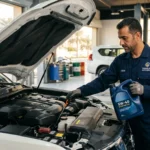
A professional oil change service is not just about replacing oil. It involves a complete inspection of engine health.
The process begins with draining old oil while the engine is warm to ensure maximum removal of contaminated fluid. The oil filter is always replaced because it traps impurities that affect oil flow and engine protection.
After refilling, technicians check oil pressure stability and engine smoothness under idle and acceleration conditions.
In experienced workshops, oil selection is not random. It is matched based on engine design, mileage condition, driving style, and manufacturer specification rather than just viscosity grade.
Engine Problems Caused by Delayed Oil Changes
In UAE workshop experience, delayed oil changes lead to predictable engine damage patterns.
One of the most serious issues is sludge buildup. This occurs when degraded oil thickens and starts blocking internal oil passages, reducing proper lubrication flow.
Another issue is increased wear on engine components such as pistons, camshafts, and bearings. Without proper lubrication, metal-to-metal contact slowly damages internal surfaces.
Turbocharged engines are particularly sensitive. Poor oil condition can quickly damage turbo bearings due to extreme rotational speeds and heat exposure.
Over time, oil seals can also weaken, leading to leaks and reduced engine efficiency.
Preventive Maintenance Approach Used in UAE Workshops
Experienced mechanics follow a preventive mindset rather than reactive repair.
Oil level checks are recommended every few weeks to detect early consumption changes. Regular oil filter replacement is equally important to maintain proper flow and filtration efficiency.
During peak summer months, many workshops shorten oil intervals slightly to compensate for extreme heat stress.
Drivers are also advised to avoid long idling in extreme heat and ensure proper engine warm-up before high load driving.
These simple habits significantly extend engine life and reduce major repair risks.
Real Engine Oil Change Cost in UAE
In Sharjah and nearby areas, engine oil service costs vary depending on oil type and vehicle category.
Basic oil change services typically range between AED 120 and AED 200. Full synthetic oil services can range from AED 200 to AED 400 for standard vehicles.
German and luxury vehicles often require higher-grade oil and specialized filters, which can increase costs to AED 300–600 or more.
Compared to engine repair costs, which can reach thousands of dirhams, oil service is one of the most cost-effective maintenance actions a vehicle owner can perform.
FAQs
How often should engine oil be changed in UAE?
Typically every 5,000 to 10,000 km depending on oil type and driving conditions.
Is 10,000 km oil change safe in UAE?
It can be risky in extreme heat and traffic conditions; shorter intervals are safer.
What happens if oil is not changed on time?
It leads to sludge formation, engine wear, and reduced performance.
Does synthetic oil last longer in UAE?
Yes, but it still degrades faster due to high temperature stress.
How can I check engine oil condition?
By checking color, smell, and consistency using the dipstick regularly.
Conclusion
In UAE driving conditions, engine oil is not just a maintenance item, it is the foundation of engine protection.
From real workshop experience in Sharjah, one conclusion is clear: engines rarely fail because of bad design, they fail because oil changes are delayed beyond safe limits.
Following a realistic, UAE-based maintenance schedule is the most effective way to extend engine life and avoid expensive repairs.